

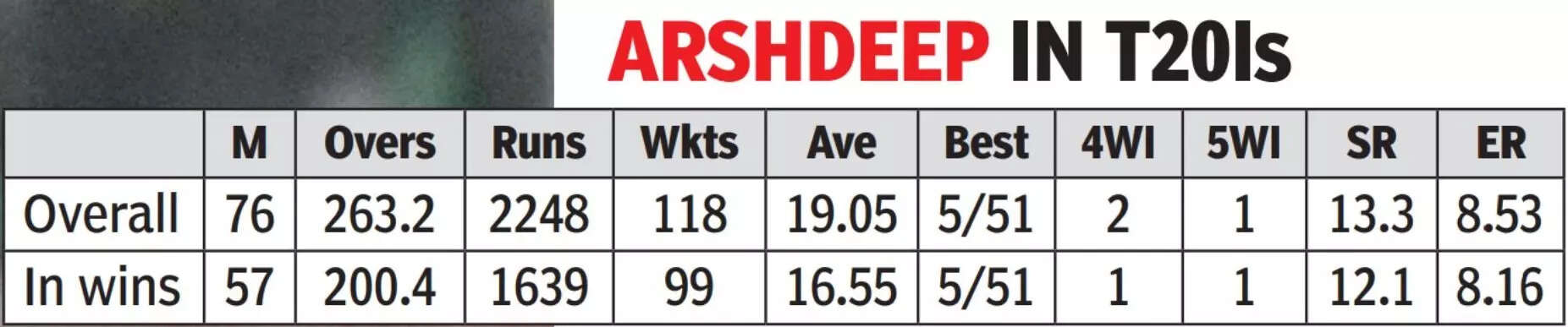
KOCHI: Arshdeep Singh’s Powerplay numbers in the last five T20Is — 141 runs from 10 overs — may invite criticism, even alarm. But context matters. Those overs were less a reflection of decline and more a consequence of deployment.Go Beyond The Boundary with our YouTube channel. SUBSCRIBE NOW!Arshdeep has been used as a blunt instrument up front, when his real value may lie in nuance, timing and choice. The inefficiency is in using him twice in the Powerplay, a move that strips India of his influence during the most pliable phase of a T20 innings — the middle overs.
Between overs 12 and 16, when batters are set but not yet unshackled, Arshdeep’s skill set is at its most disruptive. These are the overs in which pressure compounds quietly, where wickets arrive through sustained effort rather than miracle balls. Arshdeep understands how to create and sustain pressure.His evolution has been hiding in plain sight. The knuckleball that deceived Rachin Ravindra in Thiruvananthapuram was a statement of intent. Arshdeep bowls with clarity — wide yorkers that stretch the tramlines, hard lengths that grip the pitch, slower balls delivered with identical arm speed. His angles force batters to hit square rather than straight.
“Arshdeep has evolved and comes with a truckload of variations to counter batters in the middle overs. He is a fantastic proposition with the semi-old ball,” says former India and Delhi pacer Sanjeev Sharma.Not long ago, Arshdeep risked being straitjacketed into a template: two overs up front, two at the death. That approach underused his range, particularly in the middle overs when batters are searching for pace and angles rather than reacting on instinct.The second T20I against New Zealand in Raipur underlined the importance of nuance. Arshdeep bowled too full, hunting swing and yorkers on a surface that demanded a different answer. The correction required was not a wholesale change, merely sharper length management.
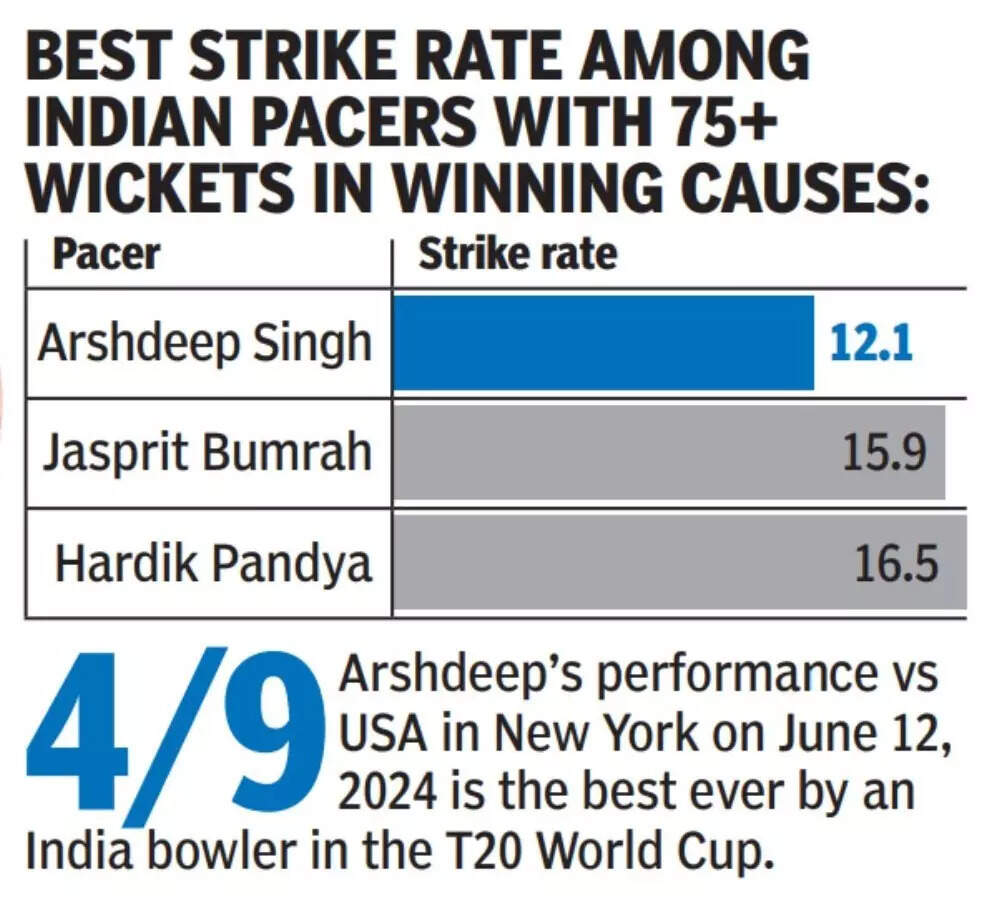
In his last 10 T20Is since Nov 2025, Arshdeep’s impact has consistently come in the middle overs, although he has been used sparingly during this phase. Against South Africa in Ahmedabad, he delivered a six-run, wicket-taking 15th over. In Vizag versus New Zealand, he bowled just one over in the middle phase and picked up a wicket. In Thiruvananthapuram, after conceding 40 runs in his opening two overs, he nabbed 4/11 in the 12th and 16th overs to extinguish the embers of a potential Kiwi heist.The pattern is clear: Arshdeep is the most effective in the middle overs. “One over with the new ball is enough to set the tone. Bring him back in the middle overs and unleash him at the death. Space him out,” Sharma said.Used in this way, India can maximise Arshdeep’s impact at the T20 World Cup.