


The Union Territory (UT) of Puducherry will go to the polls in April. A former French colony, Puducherry—earlier known as Pondicherry—continues to maintain a strong cultural connection with France.Puducherry has a unique judicial system, as a significant number of people living there are French citizens, including Indian-origin individuals who were born and brought up in the Union territory and follow French laws rather than Indian legislation, unlike the rest of the country.Puducherry’s French connection, therefore, also extends to its legal system, where some French-era laws remain in force, while others have been repealed or replaced by Indian legislation.As Puducherry heads to the polls, here is a look at some French laws that are still in effect in the UT.
How Pondicherry became French colony
Pondicherry’s association with France dates back to 1673, when the French East India Company laid the foundations of the settlement. The territory was captured by the Dutch in 1693, who held it for six years, and later by the British, who seized control in 1761 and ruled for two years.During the French Revolution, the British captured Pondicherry again in 1793, returning it to France in 1814. When the British consolidated their rule over India in the 1850s, they allowed the French to retain control of the territory.
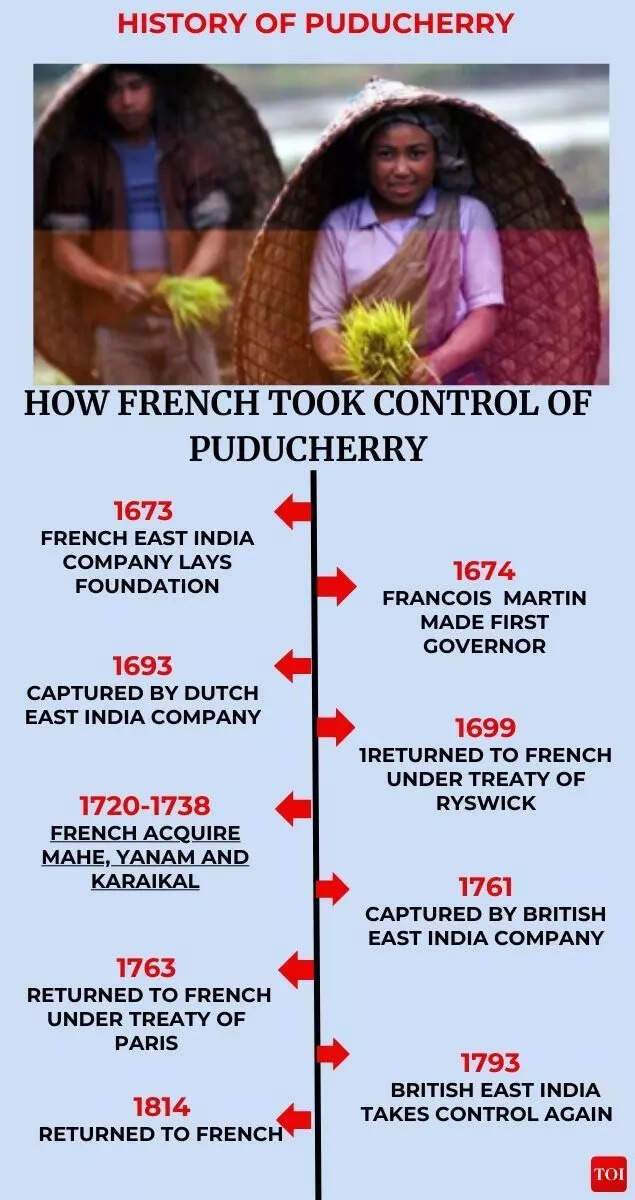
Puducherry history
Following India’s independence in 1947, momentum grew for the merger of France’s possessions in former British India with the newly independent nation.
Modern Puducherry
In October 1954, the governments of India and France reached an agreement under which France transferred its administrative authority over Pondicherry to India, with November 1 marking the de facto date of transfer.The French ceded full control of Pondicherry to India in 1962, and the region became a UT in 1963, bringing it under the direct control of the central government. The lieutenant governor, appointed by the Centre, serves as the constitutional head, while the chief minister, elected by the people, along with the council of ministers, manages the day-to-day administration.
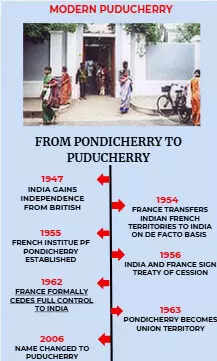
Modern Puducherry
In 2006, the Union territory was officially renamed Puducherry. Of its four districts, Puducherry—home to the capital city of the same name—and Karaikal are surrounded by Tamil Nadu, while Mahe and Yanam are enclaves within Kerala and Andhra Pradesh, respectively.
Treaty of Cession — and the ‘renoncants’
In addition to its colonial past, Puducherry has retained some French-era laws also under the Treaty of Cession signed between India and France in 1956. These laws deal with personal matters such as marriage, divorce, adoption, and succession, etc., and apply to “renoncants.”Treaty of Cession: This agreement officially transferred the French territories of Pondicherry, Karaikal, Mahe, and Yanam to India. Even though India had already taken control earlier on a de facto basis, the treaty legally finalised the transfer. It clarified important matters such as citizenship options for residents, protection of property rights, continuation of French cultural and educational institutions, and acceptance of French educational qualifications in India. The treaty contains 31 articles and came into full effect after its ratification in 1962.Renoncants: After the Treaty was ratified on 16 August 1962, the Citizenship (Pondicherry) Order, 1962, provided that French nationals living in Pondicherry, including those born there, would become Indian citizens by default. However, from that date, they were given six months to choose whether they wanted to remain French citizens or become Indian citizens. In the case of minors, the choice was made by their parent or guardian, and the minor could confirm or change this choice within six months after turning 18.Those who chose French citizenship are known as “renoncants,” a term derived from the word “renounce,” meaning “to give up.” In 1975, the-then Minister of State for Home Affairs, Om Mehta, defined renoncants as follows:

Om Mehta quote
Because renoncants are French nationals, the French Civil Code applies to them, and applies regardless of their religion.
French laws still in Puducherry
As of September 2010, the Government of Puducherry had enacted 443 acts. The UT retains its connection with France through the following laws:Official language: French is one of the five official languages of the Union territory, alongside Tamil, Telugu, Malayalam, and English. However, Tamil is by far the most widely spoken language, used by 88% of the population, which stood at 12.44 lakh as per the 2011 Census. Education: The Treaty of Cession required the Indian government to accept certain French educational qualifications as equivalent to Indian degrees, allowing holders to pursue higher education and government or administrative jobs in India. Under Article 24 of the treaty, the Indian government must ensure that the French Institute of Pondicherry continues to function as a center for research and higher education.Citizenship: Although it is generally not permitted, a non-renoncant may be eligible for French citizenship through descent. This stems from the Treaty of Cession, under which every individual in Pondicherry who was a French citizen at the time of the merger was given six months to decide which country’s citizenship they would retain, and many chose to remain French. As a result, a number of French citizens of Indian origin have been living in Puducherry for years. Marriage: Under the Prohibition of Child Marriage Act, a girl cannot marry before she is 18 and a boy not before he is 21. However, under French law, the minimum age for marriage is 18 for both genders. This means that a male renoncant can marry before he turns 21.Additionally, under the French Civil Code, the absence of free consent from even one of the two individuals, who are getting married, renders a marriage null and void.Divorce: In 2021, the Karnataka high court granted a divorce under the French law, ruling that the spouses were descendants of inhabitants of Pondicherry governed by the civil code. The court held that French law would continue to apply to renoncants and their descendants, and that other personal laws would not be applicable to the couple.Adoption and succession: The adoption and succession laws for renoncants in Puducherry can be better understood through the CS Nataraja Pillai vs. CS Subbaraya Chettiar case. The dispute involved the validity of an adoption made by a widow under French law, which was recognised by French courts but would not have been valid under British Indian law at the time. The Madras high court upheld the French court’s declaration and ruled that the adoption must be recognised because the parties were governed by French personal law in Pondicherry. The case highlights the enduring influence of French legal norms in Puducherry, particularly in matters of personal status and inheritance, and underscores why certain French laws continue to apply to renoncants and their descendants.
The Goa parallel-and differences
In many respects, Puducherry can be compared to Goa, as both were formerly European colonies. Goa, a former Portuguese colony, follows the Goa Civil Code, derived from the Portuguese Civil Code, which applies uniformly to all Goans. Portuguese influence remains visible in the Goan society even today. The Goa Civil Code:
- Authored by Viscount Antonio Luis de Seabra, a Portuguese judge
- Also known as “Seabra’s code”
- Has over 2,500 articles
- Has four parts: capacity to have and enjoy rights; marriage and succession; property; and enforcement and protection of rights
However, Goa also differs from Puducherry in several respects: it is a full state, unlike Puducherry, which is a Union Territory; unlike Puducherry’s transfer under the India–France treaty, Goa was liberated from Portuguese rule by force in 1961 (and therefore Goans born before December 19, 1961—the date on which India ended Portuguese rule in Goa—are eligible to seek Portuguese citizenship); and, unlike French in Puducherry, Portuguese is not an official language in Goa.
How Puducherry is keeping its French heritage alive
Puducherry today still vibrantly reflects its French colonial legacy. Its landmarks and monuments, such as the French Quarter (White Town), Our Lady of Angels Church (Église Notre-Dame des Anges), the French War Memorial, Aayi Mandapam, and Promenade Beach (Plage de la Promenade), showcase its Indo-French heritage through well-preserved colonial architecture. The French influence also extends to everyday life, with French cuisine, cafés, and bakeries offering croissants and baguettes alongside Tamil classics. A large number of residents still speak French and celebrate national events like Bastille Day (14 July) with enthusiasm. Together, these elements make Puducherry a living mosaic of French and Indian culture that continues to enchant visitors today.