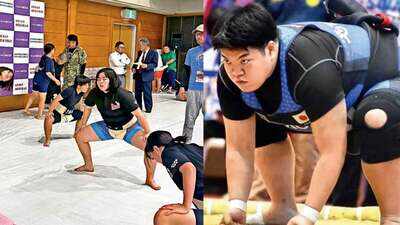
KYOTO: It’s a rainy Sunday morning but that hasn’t stopped more than 100 women and girls from making their way to the Kyoto City Budo Centre, Japan’s oldest martial arts performance hall. Built in 1899, the original structure is mostly out of bounds for visitors. But a recently built adjoining hall is buzzing with activity.The women are dressed in wrestling singlets, wearing the traditional mawashi, the thick belt associated with sumo, over it. At the centre of the hall is a ring that looks like a dohyo, the raised platform on which sumo is contested. It looks like one. But it isn’t.Women are traditionally barred from stepping into a sumo dohyo, a practice rooted in religious beliefs that have long associated menstruation with impurity. Yet, inside this hall, women are doing precisely what tradition has told them they cannot: sumo wrestling.More than 600 women in over 70 clubs practise the traditional form of wrestling in Japan, despite the resistance it has faced. In the wrestling venue at the Asian Games, when a senior official of the Japan Wrestling Association was asked about women’s sumo, he laughed before dismissing it: “It’s no sport for women.”But it wasn’t always this way. Historical research suggests women participated in sumo as far back as the fifth century. The sport also had periods of popularity between 1603 and 1868 and in the early 20th century, before women’s sumo was banned in 1926 on moral and traditional grounds.It returned in organised form in 1997. Yet, amateur women’s sumo continues to fight for survival. The Japan Sumo Association does not recognise it, leaving private clubs, schools and universities to keep it alive.At universities and a few clubs, women train alongside their male counterparts. Even the arrival of Japan’s first female prime minister has not changed the equation. Sanae Takaichi, who became prime minister last year, had said, “I respect tradition. I will not step on the dohyo.”There are, however, women like Airi Hisano, considered the strongest woman sumo wrestler of the country, trying to change things. The 27-yearold Tokyo native began with karate and judo before finding her calling in sumo at Nihon University.She was fortunate to find support at home. “My family wants me to do my best,” she said.It wasn’t easy. “Of course people made fun of me because, in rigid gender spaces, acceptance wasn’t easy. But that didn’t bother me. Also, it wasn’t an Olympic sport,” said Airi, who works in the administrative section of Tachihi Holdings.A heavyweight competitor, Airi balances training with her day job, where she also doubles as a security guard. She holds a third-degree black belt in judo and a first-degree black belt in karate. “We still have a long way to go,” she said.Not far from where Airi was preparing for her bout, Katsumasa Kawase was putting three girls from Team Shiga through their warm-up. “Being a sumo wrestler myself, I didn’t want my daughters to be denied the opportunity when they wanted to try it,” Kawase said, helping his daughters Momoka and Yuzuki warm up.The physical demands are no different from those faced by their male counterparts. The typical diet includes chicken or pork, vegetables, rice and candied sweet potatoes. But muscle is not the biggest hurdle. Awareness is.Morita, who handles public relations for Yoko Sumo Club, an all-women’s team based in Tokyo, said the club was formed in 2024 and has remained exclusively female. “A major challenge is that many people are still unfamiliar with women’s sumo,” she said.What keeps the wrestlers going? “They continue believing that the sport will eventually be included in the Olympics,” Morita said.Women coaches are still few. One of them is Mao Ueda of Hirakata Sumo Club. A former judoka and jiu-jitsu practitioner, she took up coaching after seeing an opportunity to combine her experience in martial arts with the nuances of sumo.“It’s a long road,” she said. The biggest challenge, she believes, comes after university. “With no recognition, money or future, most girls drop out after university. We need a structure to change that,” Ueda said.However, Momoka, 9, knows little about any of that. Two years into the sport, she knows only that she wants to become an Olympian.