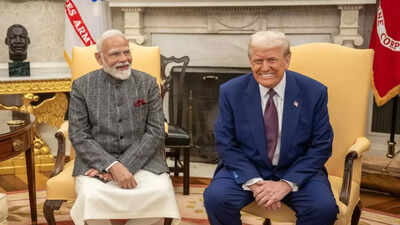
US President Donald Trump and Prime Minister Narendra Modi on February 2 surprised everyone with the India–US trade deal, announcing a reduction in tariffs on Indian goods entering the American market from 50% to 18%, lower than those faced by most Asian neighbours.Trump also confirmed that the punitive 25% duty imposed on India for buying Russian oil would be scrapped. In return, he said India had agreed to purchase $500 billion worth of US goods, reduce tariffs and non-tariff barriers on American imports to zero, and shift some of its oil purchases to Venezuela.While the agreement is yet to be formally signed and several details remain to be worked out, the announcement marked a dramatic turnaround in bilateral ties that had been under severe strain for much of the past year.The key question was how New Delhi managed to push back against the Trump administration tariff wall.
Russian oil and 50% tariff
The relationship between India and the US had sharply deteriorated after Trump imposed a steep 50% tariff on Indian goods in August, including a punitive 25% duty linked to India’s purchases of Russian crude oil and military equipment.The US President also publicly criticised India as a “dead” economy, accused it of maintaining high tariffs, and claimed that New Delhi was funding Russia’s war in Ukraine by continuing to buy discounted oil from Moscow. The remarks stung Indian policymakers and raised concerns about the future trajectory of one of India’s most important strategic partnerships.Relations worsened further after Trump repeated his claim that he had helped resolve the India-Pakistan conflict earlier this year using tariffs, a claim strongly rejected by India.In June, PM Modi also declined Trump’s request to visit the White House, where the US president was hosting Pakistan’s army chief at the time. Trump had suggested PM Modi to stop over in Washington on his way back from the G-7 summit in Canada.
Delhi’s behind-the-scenes push
In early September, shortly after PM Modi held a widely noted meeting with Russian President Vladimir Putin and Chinese President Xi Jinping in China, National Security Adviser Ajit Doval traveled to Washington to help stabilise ties.Doval met US Secretary of State Marco Rubio with a clear message. According to officials in New Delhi familiar with the meeting, Doval told Rubio that India wanted to put the acrimony behind it and return to negotiations on a trade deal. At the same time, he made it clear that India would not respond to pressure tactics. “India wouldn’t be bullied by US President Donald Trump and his top aides,” Doval said Rubio, people familiar with the matter told Bloomberg further adding that New Delhi was prepared to wait out Trump’s term if necessary, having dealt with hostile US administrations in the past.However, Doval also stressed that public criticism from the US leadership needed to be dialed down if relations were to improve. India wanted space to engage constructively without being cornered domestically, officials said.The meeting, which had not been previously reported, marked a turning point in the relationship.Not long after Doval’s visit, tensions began to ease. On September 16, Trump called PM Modi on his birthday and praised him for doing a “tremendous job” .By the end of the year, the two leaders had spoken four more times by phone, gradually rebuilding trust and momentum towards a deal. While neither the ministry of external affairs nor the Prime Minister’s Office commented publicly on the diplomatic outreach, US officials also declined to disclose details, citing standard diplomatic practice.Doval’s September meeting with Rubio was seen as a clear signal that India views the US as a long-term strategic partner and could not afford a prolonged rupture in relations.“New Delhi was never going to sever relations with Washington following last year’s downturn in bilateral relations,” Chietigj Bajpaee, senior research fellow for South Asia at Chatham House told the outlet.“India-US relations remain ‘sticky’ given the plethora of institutionalised and people-to-people linkages between both countries,” he added, while noting that earlier overly optimistic assessments of the relationship had faded. A further turning point came with the arrival of new US Ambassador Sergio Gor in New Delhi in December. A former senior White House official and close associate of Trump and Rubio, Gor in his first public speech described tensions between the two countries as disagreements among “real friends” that would be resolved.A further thaw was evident during a recent meeting between Gor and external affairs minister S Jaishankar.Gor later posted on social media that they discussed “everything from defense, trade, critical minerals, and working toward our common interests,” adding: “Stay tuned for much more!” Officials say PM Modi’s highly publicised interactions with Xi and Putin, including images of the three leaders clasping hands were intended to signal that India has options and will continue to pursue strategic autonomy.India also hosted Putin in December, highlighting a relationship that remains vital for defence supplies and diplomatic support. In parallel, New Delhi has aggressively diversified its trade partnerships.In recent months, India finalised a free trade agreement with the European Union after nearly two decades of negotiations, following a deal with the UK. Officials say these moves demonstrate India’s willingness to broaden its economic relationships amid uncertainty with Washington.Later this month, PM Modi is set to host leaders from Canada and Brazil, further deepening ties with so-called middle-power economies.India sends about one-fifth of its exports to the US, including a significant share of mobile phones and electronic goods. American companies have announced major investment commitments in India, particularly in artificial intelligence and advanced manufacturing.India is also becoming increasingly important for US financial institutions. “The larger geopolitical factors or strategic factors that bind India and the US together are still in place,” said Milan Vaishnav, director of the South Asia Program at the Carnegie Endowment for International Peace.“India requires a great amount of capital, of investment, of technology transfer. So the US is critical,” Milan added.The India-US trade breakthrough marks a significant reset after months of tension. While challenges remain including unresolved concerns over Russian oil purchases and agricultural market access, but the deal shows New Delhi’s ability to push back quietly while keeping long-term strategic priorities intact.However, neither side has released formal documentation or a joint statement outlining the full scope of the agreement.