
India-US trade deal (AI image)
India-US trade deal: While the announcement of India-US trade deal brought a welcome relief rally in domestic stock markets and cheered exporters, a lot still remains unknown about the key details of the trade agreement. The biggest takeaway from US President Donald Trump and Prime Minister Narendra Modi’s social posts is that the reciprocal tariff on Indian exports has been reduced to 18% effective immediately. Commerce Minister Piyush Goyal’s press conference on Tuesday also offered little details, though he was clear that sensitive sectors of agriculture and dairy will continue to be protected. India has secured a “very good” trade agreement with the United States, placing it in a more favourable position compared with rival nations, Goyal said.
Countries that compete closely with India in labour-intensive industries on the global stage include China, Vietnam with tariffs of 20%, Malaysia at 19%, Bangladesh at 20%, and Cambodia and Thailand, both facing duties of 19% each.Trump’s post on Truth Social made several claims on tariff rates, India’s oil purchase strategy, halting of Russian crude imports, stepping up purchase of US goods and much more. India on its part has not endorsed most of these claims, and several questions related to the India-US trade deal remain unanswered:
Q.1 Will India stop buying Russian crude oil?
What Trump said: “He (PM Modi) agreed to stop buying Russian Oil, and to buy much more from the United States and, potentially, Venezuela. This will help END THE WAR in Ukraine, which is taking place right now, with thousands of people dying each and every week!”What we know so far: India has not officially said that it will stop buying Russian crude oil. Indian refiners have not received any directive from the government to halt purchases of Russian crude and would require time to wind down transactions that are already underway, two refinery sources told Reuters.Also Read | India-US trade deal: 25% penal tariffs linked to Russian oil gone? White House confirms, but there’s a catchIndia’s imports of Russian crude had touched a high of about 2 million barrels per day in June last year. Trump said on Saturday that India would purchase oil from Venezuela. However, refinery officials noted that only Reliance Industries and Nayara Energy possess the technical capability to handle large volumes of heavy crude. According to the sources quoted by Reuters, state run refiners cannot easily switch to Venezuelan oil and would be able to substitute less than 10% of the volumes currently sourced from Russia. Trade data showed that India’s Russian oil imports slipped to a two year low in December.
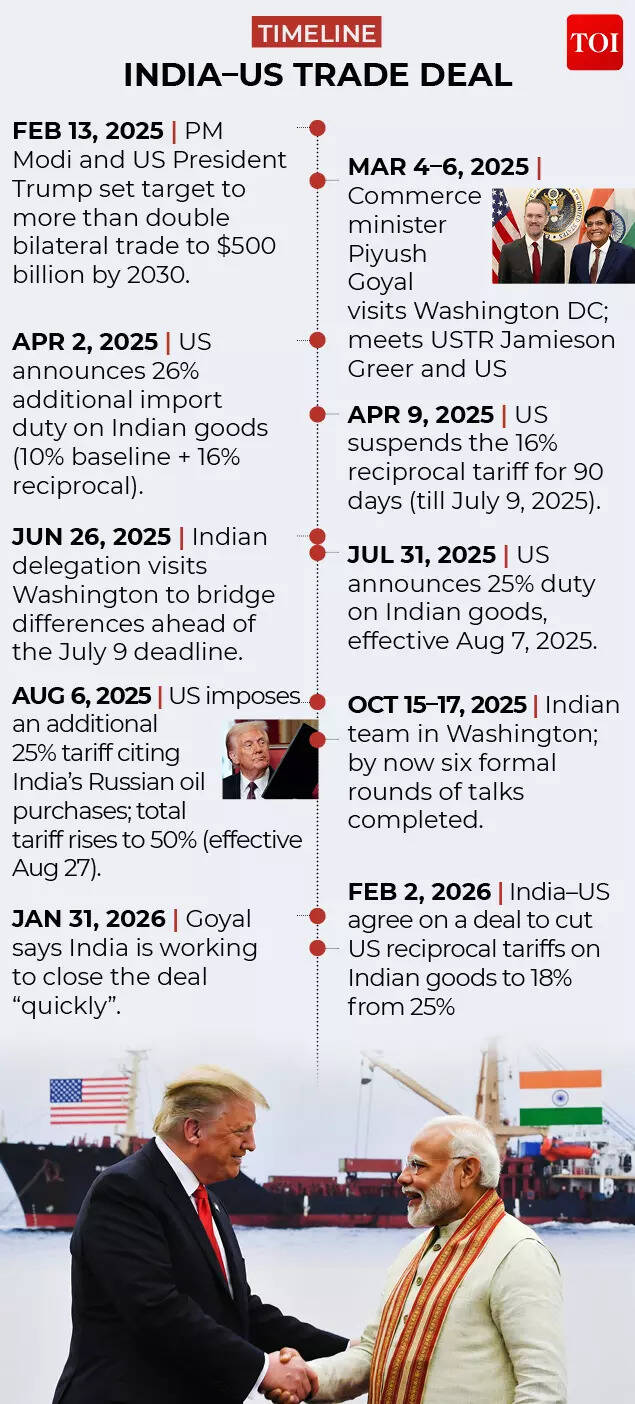
India-US trade deal timeline
Indian refiners have increasingly turned to suppliers in the Middle East, Africa and South America as they gradually cut back on Russian crude purchases, a trend that became evident last month.Meanwhile, Russia has also not received any official communication from India indicating any move to halt purchases of Russian crude, Kremlin spokesperson Dmitry Peskov said on Tuesday.”“We haven’t heard any statements from New Delhi on this matter yet,” Peskov said.The Kremlin spokesperson added that Moscow plans to continue strengthening its relationship with India across all areas of cooperation.
Q2. Will India reduce tariffs on American goods to zero?
What Trump said: “Out of friendship and respect for Prime Minister Modi and, as per his request, effective immediately, we agreed to a Trade Deal between the United States and India, whereby the United States will charge a reduced Reciprocal Tariff, lowering it from 25% to 18%. They will likewise move forward to reduce their Tariffs and Non Tariff Barriers against the United States, to ZERO.”Commerce Minister Piyush Goyal has not clarified on whether tariffs on US goods to India will be brought down to nil. In his statement to the media, he explained that the final details of the trade deal are still being worked out and a joint statement will be issued soon.Also Read | Lower than Pakistan, China: How trade deal with US gives India its edge back against South Asian competitors PM Modi’s social media post after Trump’s trade deal announcement also did not talk of tariff barriers on US goods. It welcomed the reduction of tariffs to 18%.US Trade Representative Jamieson Greer said on Tuesday that the Trump administration is in the process of formally concluding the trade pact announced with India, while pointing out that New Delhi continues to retain safeguards for its agricultural sector.In an interview with CNBC, Greer said the agreement was now being put into final form. “We’ll finish papering it, but we know the specifics, we know the details,” he said. He also noted that as the wider deal progresses, India “is maintaining some protection around agricultural goods.”Greer added that the agreement would substantially liberalise India’s industrial market, with a sharp reduction in duties on manufactured products.“India’s industrial goods tariffs will go to zero from 13.5%,” he said.
Q3. Will India buy US goods worth $500 billion and what’s the timeline for this?
What Trump said: “The Prime Minister also committed to “BUY AMERICAN,” at a much higher level, in addition to over $500 BILLION DOLLARS of US Energy, Technology, Agricultural, Coal, and many other products.” While Trump’s post mentions agricultural products, Piyush Goyal that the India-US trade deal will protect the agricultural and dairy sectors. Also, there is no word from India on any commitments to step up US energy, technology, coal purchases.As Global Trade Research Initiative (GTRI) notes: Trump claims India will reduce tariffs and non-tariff barriers on US products to zero, but does not specify how many products are covered under India’s commitment. India has previously resisted opening sensitive sectors such as food grains, genetically modified products, and other regulated imports.Also Read | India-US trade deal: Top 7 points Trump says he agreed on with PM Modi“Trump says India will buy over $500 billion of US goods. At present, India’s annual imports of goods and energy from the US are under $50 billion. Reaching $500 billion would likely require more than 20 years, suggesting the figure refers to a long-term aspiration rather than a near-term commitment,” GTRI says.More clarity on key aspects of the India-US trade deal are expected to emerge in the coming days – for now exporters are breathing a sigh of relief that dealings with India’s largest trading partner are back on track.