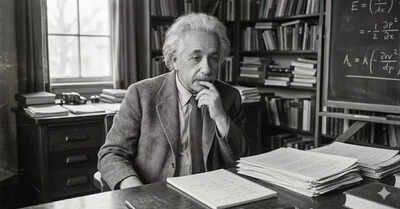
Every generation invents its own scoreboard. Ours prefers the numerical kind. Percentiles decide streams, cut-offs decide colleges, packages decide credibility. Even curiosity is quietly trained to ask a transactional question first: Will this be evaluated?In such an economy of numbers, a line attributed widely to Albert Einstein—“Try not to become a man of success, but rather try to become a man of value”—is usually read as a noble aside. Something to frame on a wall, not to organise a life around.That reading underestimates Einstein. It draws a hard line between what systems can reward and what the world eventually requires. For students moving through exam-heavy education, the line could not be more relevant.Einstein’s warning begins with a simple insight: Success is externally conferred. Value is internally built. One arrives quickly. The other compounds slowly.Exam culture is exceptionally good at producing measurable success. But it often narrows the definition of excellence to what can be timed, ranked, and standardised. When students are trained to optimise for a format, they become fluent in performance—sometimes at the cost of understanding.This is why Einstein’s line bites. It asks students to build something deeper than scores: A set of capacities that still function when the scoreboard disappears.
Value moves from education to work
Long before modern test culture peaked, Paulo Freire described what happens when education reduces students to receivers. In Pedagogy of the Oppressed, he writes: “Education becomes an act of depositing, in which the students are the depositories and the teacher is the depositor.”Freire’s “banking model” explains why exam-driven schooling can produce students who are brilliantly successful inside structure and surprisingly fragile outside it. Deposited knowledge is easy to withdraw in a test; it is harder to use in an unstructured problem.Einstein’s “value” is what Freire implies but does not romanticise: Understanding that is owned, not borrowed; thinking that works when the question is unfamiliar; learning that isn’t hostage to a template.Education systems tend to reward compliance with structure because organisations reward it too. Standardised success produces predictable workers—comfortable with instructions, metrics and supervision. Value, by contrast, lies in judgement, dissent and the ability to reframe a task. That is precisely what travels unevenly into workplaces, and what the market says it wants even as it quietly resists it.
Unstable times demand durability, not just distinction
The contemporary world is marked by volatility: economic shocks, technological disruption, shifting career paths. In such conditions, distinction is fragile. Durability matters more.Durability comes from value, from skills that age slowly: Thinking clearly, learning continuously, communicating effectively, acting responsibly. Students who invest in these capacities may not always top the list, but they stay employable, adaptable, and relevant. This is not a rejection of ambition. It is an upgrade to it. Success can open doors; value keeps them open.
Why value, not success, is the only durable achievement
Value is not goodness, and it is not virtue worn lightly. It is readiness—the intellectual and moral capacity to act responsibly when no one is awarding marks, when there is no rubric to hide behind, and when outcomes have consequences that cannot be appealed. Exam cultures rarely teach this kind of readiness. They stage meritocratic theatre instead: fair in appearance, competitive in design, reassuring to those who rise and quietly brutal to those who fall.As Michael Sandel argues in The Tyranny of Merit, such systems do more than sort talent. They manufacture psychology. Winners are taught to see success as destiny, a personal triumph that confirms their worth. Those who fall short are left with a quieter inheritance—humiliation, self-doubt, the sense of having failed not a test but a moral exam of life itself.Einstein offers a way out that is neither sentimental nor forgiving. He shifts the question from identity to contribution. Success, when treated as who you are, becomes fragile—easily threatened, endlessly defended. Value, when treated as what you add, becomes durable. It is not about beating others, but about improving what you touch. And in a world that keeps rewriting its rules, that capacity—to contribute responsibly, again and again—is the only achievement that truly lasts.