
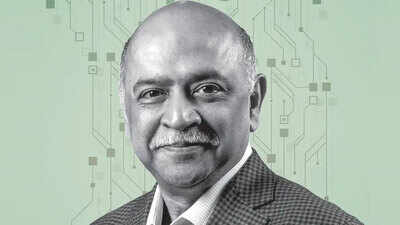
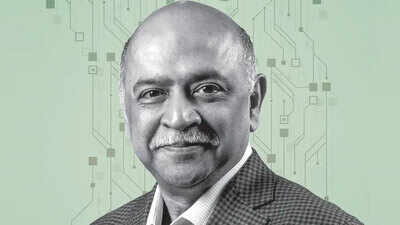
Artificial intelligence is often described as a race to build bigger and more powerful models. But Arvind Krishna, chairman and CEO of IBM, is taking a different view. The IIT Kanpur graduate believes that the future of AI will not necessarily belong only to companies spending billions of dollars training the largest general-purpose models.Krishna has been named among TIME’s 100 Most Influential People in AI for 2026, recognising his role in shaping how businesses adopt artificial intelligence. His approach is centred on a less flashy but potentially crucial question: how can companies use AI reliably for specific, high-value tasks?From IIT Kanpur to IBM’s top jobKrishna completed his undergraduate degree in electrical engineering at IIT Kanpur before earning a PhD in electrical engineering from the University of Illinois Urbana-Champaign.He joined IBM in 1990 and went on to hold several senior positions, including leading IBM Research and the company’s Cloud and Cognitive Software business. He became IBM CEO in 2020 and chairman later that year.His career has therefore followed the evolution of computing from traditional enterprise systems towards cloud computing, AI and now generative AI.IBM says Krishna has extensive experience in artificial intelligence, cloud and quantum computing.Why IBM is not simply chasing the biggest AI modelIBM’s AI strategy differs from the approach taken by companies focused primarily on massive foundation models.The company has emphasised smaller, specialised models designed for particular enterprise applications. In a 2025 interview with TIME, Krishna argued that smaller models requiring significantly less computing power can still be successful when they are designed for the right tasks.That strategy is particularly relevant to industries such as finance, healthcare and manufacturing, where accuracy, reliability, security and control can matter more than a model’s ability to answer every possible question.IBM has also built its AI strategy around helping businesses integrate artificial intelligence into existing workflows rather than simply giving employees access to a chatbot.Why this matters for engineering studentsKrishna’s career offers a useful lesson for students watching the AI boom.The most visible part of artificial intelligence may be chatbots and image generators, but enterprise AI involves a much wider engineering ecosystem. It includes cloud infrastructure, specialised models, data management, cybersecurity, automation and systems engineering.For engineering students, that means the AI job market is unlikely to be limited to training frontier models. Skills in computer science, electrical engineering, mathematics, cloud computing and domain-specific problem solving can all become relevant.A different vision of the AI raceKrishna’s inclusion in TIME100 AI 2026 is significant partly because it represents a different side of the AI revolution.While companies such as OpenAI and Anthropic compete at the frontier of general-purpose intelligence, IBM is betting that businesses will also need AI systems that are smaller, specialised and dependable.That makes Krishna’s journey from IIT Kanpur to the top of IBM particularly relevant for students trying to understand where AI careers may go next.The AI race may be about building increasingly powerful systems. But it may also be about making those systems useful, affordable and reliable enough to become part of everyday business.Disclaimer: This article is based on publicly available information and statements from the individuals and organisations cited. TOI Education has not independently verified all claims, figures or technical performance mentioned in the article.