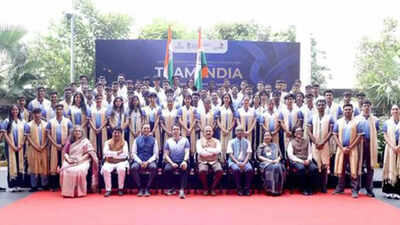
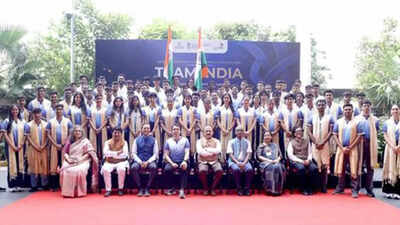
SHANGHAI: Fifteen years ago, India stood 39th in a global competition that tests whether young people can actually make, repair, design, build and deliver to international occupational standards. On Sunday, it broke into the top 10 for the first time. More telling than the jump itself was where the results came from — bakery and dental prosthetics to digital design, logistics and retail — signalling a skills base widening beyond India’s traditional trades.India finished 10th at WorldSkills Shanghai 2026 with six silver medals and 20 Medals for Excellence, improving from its 13th-place finish at Lyon in 2024, where it had won four bronze medals and 12 Medals for Excellence. China topped the Shanghai standings, followed by Korea and Chinese Taipei.India’s six silvers came through Smriti Nambiar in Bakery, Mohammed Salam in Dental Prosthetics, Kovid Ajay Gangrade in Digital Interactive Media Design, Parth Vohra in Industrial Design Technology, Mehrunissa Begum in Logistics and Freight Forwarding and Saniya Joshi in Retail Sales. Nambiar was also named India’s Best of the Nation competitor.Three of the silvers — Dental Prosthetics, Digital Interactive Media Design and Retail Sales — came in categories India entered for the first time, making the performance significant beyond the medal count. India debuted in 11 disciplines in Shanghai, including unmanned aerial systems, intelligent security technology, software testing, aircraft maintenance and optoelectronic technology.Another 20 Medals for Excellence came across a wide spread of occupations, including mechatronics, autonomous mobile robotics, Industry 4.0, additive manufacturing, robot systems integration, automobile technology, chemical laboratory technology, jewellery, fashion technology and health and social care. The medallions are awarded to competitors who demonstrate a high level of professional proficiency against WorldSkills standards.India’s rise has been steady. From 39th in London in 2011, it improved to 33rd in Leipzig in 2013, 29th in São Paulo in 2015 and 19th in Abu Dhabi in 2017. Kazan 2019 brought a breakthrough to 13th and India’s first WorldSkills gold. After again finishing 13th at Lyon, Shanghai has now taken India into the top 10.The scale of India’s participation has expanded too. Its largest-ever contingent of 70 competitors took part across 63 skills, spanning advanced manufacturing, engineering, digital technologies, creative industries and specialised services.Congratulating the team, minister of state for skill development and entrepreneurship Jayant Chaudhary said: “Team India’s remarkable performance at WorldSkills Shanghai 2026, with 6 Silver Medals and 20 Medallions for Excellence, marks a significant leap in our global skills journey. Surpassing our previous performance, our young competitors have demonstrated the growing strength and competitiveness of India’s skilled talent. I congratulate every competitor, expert, trainer and industry partner who contributed to this achievement. Beyond the medals, what makes us proud is the confidence, determination and excellence with which our youth represented India on the world stage. Their success reinforces our commitment to building a future-ready skilling ecosystem and giving every young Indian the opportunity to compete with the best in the world.”Manisha Sensarma, official delegate, WorldSkills India and senior economic adviser in the ministry, said the value of the competition extended beyond medals. “WorldSkills is as much about learning as it is about competing. Shanghai has given our competitors and experts invaluable exposure to evolving global occupational standards, new technologies and international best practices. Our focus now is to translate these learnings into stronger training methodologies, improved assessment standards and deeper industry engagement, so that the benefits of this experience extend well beyond the competition to India’s larger skilling ecosystem.
Share your thoughts in the comments
Be respectful · TOI community guidelines
”That may be the larger significance of India’s 10th-place finish. Shanghai shows that its best young trainees can increasingly compete across a much wider spectrum of occupations. The next test is whether the standards, training practices and industry exposure behind that performance can be translated into improvements across the country’s broader skilling ecosystem.