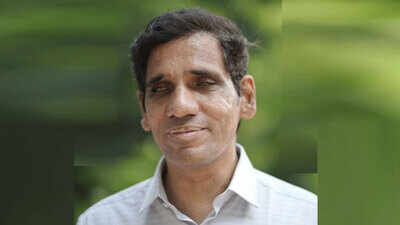
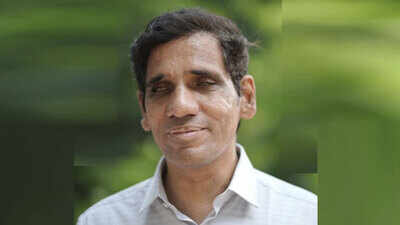
For many students, the journey from school to higher education is filled with familiar challenges — examinations, competition, financial pressures and the uncertainty of choosing a career. For Prof Hemachandran Karah, the path involved an additional barrier: navigating an education system that was not always designed with visually impaired students in mind.Yet his journey took him from the Little Flower School for the Blind in Chennai to the University of Cambridge and eventually to IIT Madras, where he is now an Associate Professor in the Department of Humanities and Social Sciences.His story is not simply about academic achievement. It is about how education, technology, mentorship and persistence can challenge assumptions about what students with disabilities can achieve.
A teacher who taught him to dream bigger
Prof Karah has spoken about the important role his teachers played during his early education. Among them, his teacher Vincent Sir had a particularly significant influence.Rather than allowing disability to define the boundaries of his ambitions, his teacher encouraged him to think beyond them and consider opportunities such as studying internationally.That mentorship became an important part of Karah’s educational journey.His experience also highlights the influence that teachers can have beyond textbooks and examinations. For students facing circumstances that may make their ambitions seem unrealistic, a teacher who says you can do this can sometimes become the person who changes the direction of an entire life.Karah went on to pursue higher education and eventually completed his PhD at the University of Cambridge, UK.Today, he is a faculty member at IIT Madras, where his own experiences have influenced the way he thinks about education and accessibility.
At IIT Madras, his focus goes beyond the classroom
As an Associate Professor, Karah works in the area of Disability Studies, while also contributing to efforts to make educational and public spaces more accessible.He is a founding member and principal investigator of the Accessibility Research Centre (ARC) at IIT Madras. Through the centre, he and his colleagues work on issues surrounding disability and disciplines, including developing teacher tutorials and examining how museums and other knowledge spaces can become more accessible.For Karah, inclusion is not simply about providing special facilities. It is also about changing the assumptions society makes about people with disabilities.He has spoken about the need to challenge what he calls societal “common sense” barriers — assumptions about what a person with a disability can or cannot study, whether they can work in a particular discipline, or what kind of career they can pursue.His message is particularly relevant to education: accessibility should not mean lowering expectations. It should mean removing barriers that prevent students from meeting those expectations.
He sees a teacher as a guide, not a parent
Karah’s philosophy towards students is also shaped by his understanding of education as a process of independence.He has described his role as being more of a guide than a parent to his students. For him, higher education is not merely about academic performance. Universities also have a responsibility towards students’ social integration and wellbeing.This perspective becomes particularly significant when discussing students with disabilities. An inclusive institution, he believes, should not isolate students or define them primarily through their disabilities. Instead, it should create an environment in which students can participate fully in academic and social life.
Why ‘blind photography ’ matters to him
One of the most unusual aspects of Karah’s work and interests is his engagement with blind photography.At first, the concept may appear contradictory: how can someone who cannot see photograph the world?Karah’s explanation challenges that assumption.For him, photography is not simply about looking through a camera and pressing a button. It can involve sound, touch, conversation, technology, collaboration and the individual’s own interpretation of a place or moment.He describes blind photography as having therapeutic and creative value. It can allow visually impaired people to participate in experiences such as photographing a day at the beach, while also helping people who are losing their sight remain connected with their surroundings.It can even become a research tool, with visually impaired photographers working alongside sighted collaborators or “co-creators” to document and narrate visual experiences.In that sense, blind photography becomes another way of questioning society’s assumptions about disability.
Education that removes barriers, not aspirations
Karah’s journey from a school for visually impaired students to Cambridge and IIT Madras carries a message that extends far beyond his own academic achievements.He has demonstrated that inclusion is not about creating a separate definition of success for people with disabilities. It is about ensuring that disability does not become an artificial limit on ambition.His work at IIT Madras, his research in Disability Studies and his efforts to make knowledge spaces more accessible continue that idea.Away from academia, Karah also finds joy and emotional connection through music, particularly the compositions of Ilaiyaraaja, which he describes as therapeutic.His journey ultimately offers an important lesson for students, teachers and institutions alike: the purpose of education is not merely to prepare students to pass examinations, but to give them the confidence, opportunity and freedom to imagine possibilities that others may not have imagined for them.And sometimes, the most powerful beginning is a teacher who simply tells a student to dream bigger.