
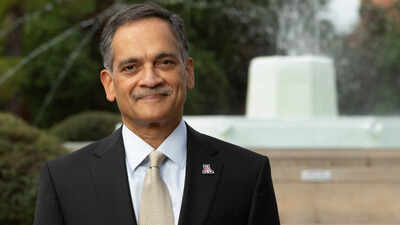
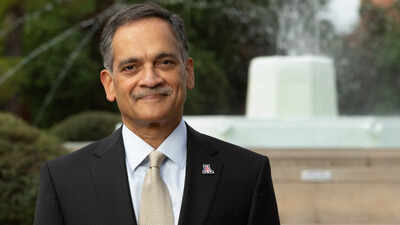
Suresh Garimella is the President of the University of Arizona and a distinguished professor in the department of mechanical and aerospace engineering. Focused on building a strong, aligned leadership team and ensuring long-term financial health for the institution, Garimella has consistently championed student access and affordability.Previously President of the University of Vermont, as well as the Goodson Distinguished Professor of mechanical engineering and executive vice president for research and partnerships at Purdue University, he earned his bachelor’s degree from the Indian Institute of Technology Madras before moving to the US. A highly cited scholar, Dr. Garimella was appointed to the newly established office of science advisory committee for the US Department of Energy earlier this year.In an exclusive interview with Ishani Duttagupta, he discusses his deep connection with the global IIT alumni network, the contribution of Indian students to his university, and more. Edited excerpts:In your role, leading the University of Arizona, what have been the most complex leadership challenges you have faced?Every leader and every university faces moments that test their resilience, but I have found that the most effective leaders remain focused on a clearly articulated mission while bringing people together around a shared vision for the future. Public higher education is changing rapidly. Universities are being asked to prepare students for career paths that are continually and rapidly evolving, accelerate research that addresses society’s most pressing challenges and demonstrate their value to the communities they serve. Meeting those expectations requires both disciplined decision-making and the ability to unite people around a common purpose. At the University of Arizona, that has meant making difficult decisions while keeping our eyes firmly on the future. We have strengthened our financial foundation, brought greater focus and discipline to our priorities and positioned the university to build on its considerable strengths. I believe leadership is ultimately about creating the conditions for talented people to succeed. When people understand where an institution is going, how their work contributes and what success looks like, remarkable things become possible.What are the current trends for international student enrolment from India at the University of Arizona? Are numbers fluctuating, and how is the university actively recruiting global talent?India continues to be one of the University of Arizona’s most important international partners, and Indian students make extraordinary contributions to our campus community through their scholarship, research and leadership. Like at many universities, international enrolment naturally fluctuates in response to global conditions, but our long-term commitment to India remains strong. We continue to explore and secure partnerships with Indian institutions and industry, especially building on areas in which we rank at the top in the world. The future of higher education will increasingly be defined by global collaboration. Whether addressing advances in artificial intelligence, health care, water resources and sustainability, or semiconductor manufacturing, universities must work together to prepare the next generation of leaders and solve challenges that no single institution or nation can address alone. That spirit of collaboration is central to our vision at the University of Arizona.A growing number of Indian Americans now lead major US universities. Did your journey as an immigrant present unique institutional or cultural hurdles, and how did you navigate them?Moving to live in another country is an exercise in learning and in adapting. Every institution has its own culture and expectations, but I quickly discovered that curiosity and integrity with a sense of purpose transcend borders. My education at IIT Madras and before, as well as at Ohio State and at the University of California Berkeley, gave me an outstanding technical foundation, and perhaps more importantly, it instilled discipline and a lifelong commitment to learning. Those lessons have stayed with me throughout my career. I have also been fortunate to work alongside exceptional mentors, colleagues and students from many different backgrounds. Those experiences have reinforced my belief that universities are strongest when they bring together people with diverse perspectives in pursuit of shared goals. Some of our greatest innovations, and our greatest opportunities, come through learning from one another.Looking back at your time at IIT Madras, what specific elements of that rigorous educational foundation gave you a competitive edge in your American academic career?IIT Madras challenged us to think critically and take on complexity with confidence. It taught us to remain curious and continue learning throughout our lives. It was a hyper-competitive atmosphere, but perhaps that helped me discover my core strengths and built resilience. My training prepared me well for graduate study in the United States, and it shaped my approach to leadership. Whether in research or university administration, progress begins with asking the right questions and listening carefully. Bringing together talented people with different perspectives is invaluable. The challenges facing higher education, and society more broadly, are increasingly complex. Solving them requires institutions that are willing to innovate, partner strategically and remain focused on uplifting society.AI is rapidly transforming higher education. Do you view it primarily as a disruptive operational challenge for universities, or a tool for academic advancement?Artificial intelligence offers a generational opportunity. As chair of the US Department of Energy’s Genesis AI Mission advisory subcommittee, I would like to emphasize the opportunity and the challenge. Like every transformative technology, AI presents challenges that must be addressed thoughtfully, but it also has tremendous potential to accelerate discovery, improve teaching and prepare students for a rapidly changing workforce. Our responsibility is to help students think critically, apply these technologies ethically and develop the creativity, judgment and leadership that remain uniquely human. Throughout history, universities have helped society navigate periods of profound change. AI is no different. Public research universities have both the opportunity and the responsibility to ensure these technologies are developed and applied with humanity at the core.How do you successfully balance your role as an active researcher and academic with the demanding administrative responsibilities of a major university president?My research and teaching career has fundamentally shaped how I approach leadership. Engineers are trained to ask questions, rely on evidence and solve complex problems collaboratively. Those same habits are invaluable in leading a university. Although I spend less time directly conducting research today, remaining engaged with our faculty, students and research enterprise keeps me connected to the university’s core mission. Great public research universities create opportunity. They prepare students to lead, advance discoveries that improve lives and serve as engines of economic growth and societal progress. At the University of Arizona, success for every student is our North Star. My responsibility is to help create an environment where students, faculty and staff can thrive, where discovery translates into opportunity and where our work uplifts the people of Arizona and communities around the world.I also enjoy staying connected with cutting-edge research in my roles providing strategic research leadership through advisory committees for the National Science Foundation, US Department of Energy, and Sandia National Laboratories among others.In what ways do you stay connected to your Indian roots today, and how active are you within the global IIT alumni network?India will always be an important part of who I am. I remain connected through family, lifelong friendships, professional colleagues and the global IIT alumni community. Those relationships continue to be an important part of my personal and professional life. I also value opportunities to remain engaged with higher education leaders across India, including through my role as Chair of the Global Advisory Council for the Confederation of Indian Private Universities. I maintain a longstanding commitment to strengthening collaboration between universities in India and the United States and creating opportunities for institutions to learn from one another.As Arizona’s flagship, land-grant university, we believe our responsibility extends beyond our campus. We are committed to building partnerships that expand educational opportunity, strengthen research and create meaningful impact for the communities we serve. I believe India’s universities will play an increasingly important role in shaping the future of higher education, and I look forward to strengthening those relationships in the years ahead.What do you consider your most impactful achievement or turnaround success since taking office at the University of Arizona?I am deeply proud of what our university community has achieved together. Since coming to the University of Arizona, we have restored financial stability by eliminating the university’s $177 million budget deficit while continuing to invest in our people and keeping resident undergraduate tuition flat for three consecutive years to preserve access and affordability.
Share your thoughts in the comments
Be respectful · TOI community guidelines
We implemented a new enrolment management strategy that creates multiple pathways to the university while investing in the academic and well-being programs students need to graduate in four years with minimal debt and pursue strong career opportunities. That commitment includes making counselling services available to students at no cost, removing a financial barrier to care and helping ensure students have the support they need to thrive. We are equally committed to preparing students to succeed in an increasingly interconnected world. One example is the expansion of our Study Abroad program, made possible by a generous $20 million gift from the Garcia Family Foundation. This investment will provide international experiences to students who otherwise might not have had the opportunity to study abroad, broadening their perspectives and better preparing them to lead in a global economy. We continue to build momentum. Our responsibility is to serve as a force for good for Arizona and beyond. That is the work that inspires me every day.