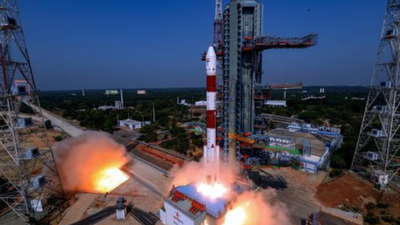


On August 23, 2023, when ISRO’s Chandrayaan-3 landed near the Moon’s south pole, India swelled with pride. It was a triumph that captured the world’s imagination. And blood in our veins flowed with pride for our ISRO scientists. It is less than three years now, but now we have an entirely different story. Dreaming of being a part of ISRO is not child’s play, let alone being one. It is that dream which is nurtured by millions of young hearts. It is an institution that engraves history. However, here we are having a completely different script. The conversation has transcended from spacecrafts to the resignation of scientists.Less than three years later of Chandrayaan mission, more than 100 scientists have reportedly resigned or sought voluntary retirement from the ISRO in just a few months. The government’s response has been swift. Scientists working on critical programmes like Gaganyaan will now require approval from the Department of Space before they can leave.That decision has been taken to slow the exits. However, it somehow falls short to answer the question that really matters: Why are some of India’s brightest scientific minds walking away from one of the country’s most prestigious institutions?Because no organisation loses talent overnight. People leave when the future outside begins to look more exciting than the future within. And that is precisely the challenge staring ISRO in the face.
The real competition isn’t NASA anymore. It’s next door.
For decades, ISRO had a luxury very few employers enjoy, it had no real competition. If an aerospace engineer wanted to build rockets in India, there was only one destination. If a scientist dreamed of designing planetary missions, the choice was already made. That era is over.The opening of India’s space sector in 2020 has rewritten the rules. Suddenly, ambitious engineers no longer have to wait decades to lead a project. They can join a startup, build a launch vehicle, own equity in the company and watch their ideas become reality within months rather than years.The irony claps harder and is becoming impossible to ignore. ISRO spent decades creating India’s space ecosystem. That very ecosystem is now competing for its best people.This is not a failure of India’s private space industry. It is proof that the sector has finally matured. The question is whether ISRO has matured with it.
Are scientists really resigning from missions?
Whenever the stories of resignation comes up, the salary becomes the chief protagonist. Coneninent though, but maybe a wrong reason for this. It is tempting to reduce the issue to salaries.Scientists rarely join ISRO expecting corporate pay packages. They join because they want to solve problems that very few people in the world get to solve.But purpose alone cannot sustain a career forever. When promotions move slowly, decisions take months, approvals pile up and bureaucracy overshadows innovation, even the most passionate professionals begin taking difficult steps.Those questions become even louder when private companies offer not only better compensation but also greater autonomy.People seldom leave because they stop believing in the mission. They leave because they stop believing the system allows them to do their best work.
With every resignation, experience walks out of the door
Replacing a scientist might sound simple. Recruit another one, train them, assign tasks and ta da! But, in reality it is not so. Real life works differently.The scientist who helped design Chandrayaan’s landing sequence or spent years perfecting a propulsion system carries knowledge that exists nowhere else, not in manuals, not in software and not in presentations.Scientific institutions don’t merely employ people. They accumulate experience. Every resignation chips away at that institutional memory. The damage is invisible at first. Years later, it begins to show.
Can restrictions really create loyalty?
The Department of Space’s latest order reflects the seriousness of the situation. But restricting resignations is a management response to a cultural problem. Employees stay because they want to. Not because leaving becomes difficult.History offers countless examples of organisations trying to solve retention through rules rather than reform. Very few succeed.Retention is earned. It cannot be legislated. ISRO may need its biggest transformation since its founding. India’s space ambitions have expanded dramatically. The country wants astronauts in orbit. It wants reusable rockets. It wants a space station. It wants a greater share of the global commercial launch market.All of that requires one resource more valuable than launch vehicles or satellites. Talent.That means ISRO may have to rethink long-held assumptions about how a government scientific organisation should function.
- Should career progression become faster?
- Should scientists get greater ownership over projects?
- Should compensation reflect market realities?
- Should bureaucracy give way to greater scientific autonomy?
These are uncomfortable questions. Ignoring them will not make them disappear.If India’s brightest scientists increasingly find their future outside ISRO rather than within it, the country’s greatest space challenge will not be reaching Mars or building a space station.It will be retaining the minds capable of making those dreams possible. Because in the end, rockets don’t build themselves. People do.